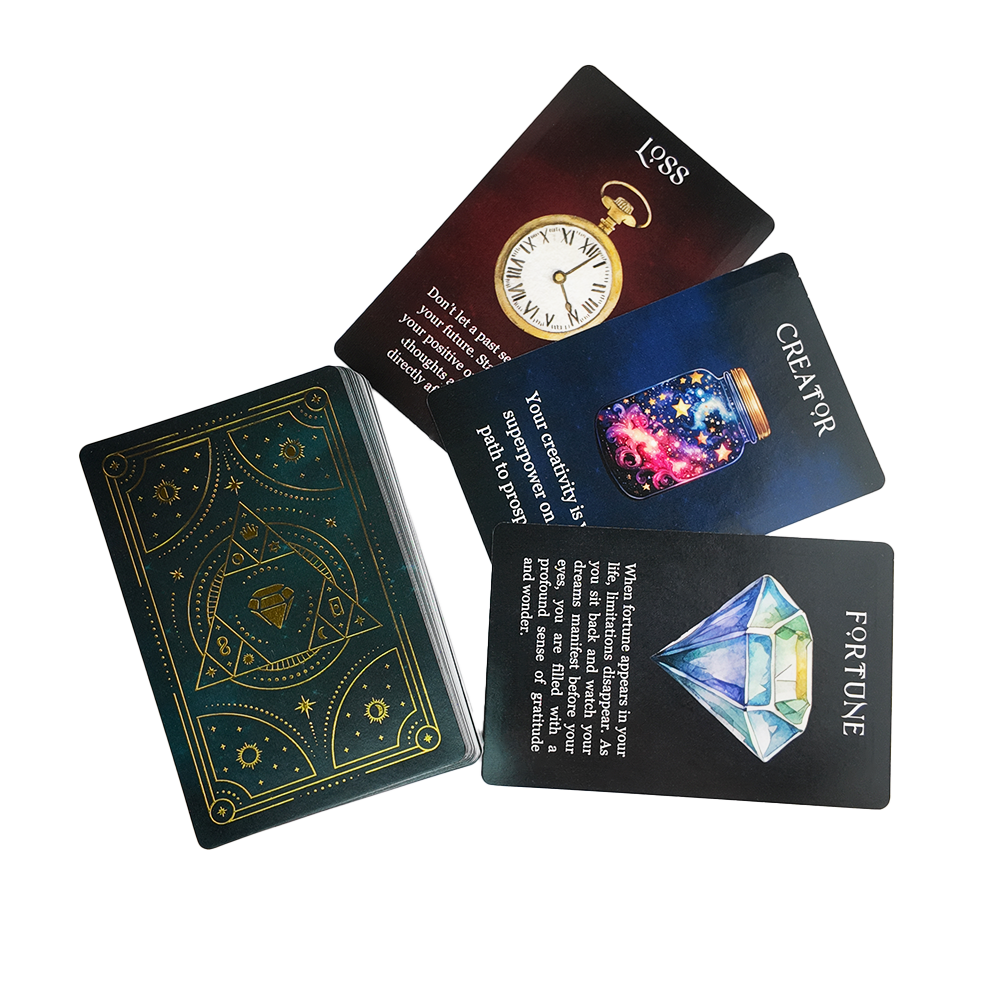
Most delays in oracle deck production do not begin at the press. They begin when the deck list, artwork files, finishing instructions and packaging contents describe slightly different products. A beautiful card design cannot correct an unapproved card sequence, a box built around the wrong stack height or a foil layer that never reached prepress.
THRIWA's published OEM/ODM workflow uses five connected stages: inquiry and specification, artwork and prepress, production and printing, die-cutting and assembly, then quality control and shipping. This guide applies that factory route specifically to oracle decks. Instead of repeating a general catalogue of card sizes and finishes, it shows what must be controlled at each handoff and what evidence is needed before the next stage is released. For available oracle formats and packaging, see THRIWA's custom oracle card printing service.
An oracle deck is a small product system. Unique card faces must match the approved sequence, a shared back must stay consistent, the guidebook must refer to the correct cards, and the packed set must fit the selected box. Treating those components as separate purchases creates avoidable version and fit problems.
For production control, THRIWA needs one approved description of the finished set. That description should answer three practical questions:
The brief is the reference used by sales, prepress and production. It is more useful than a long email chain because each downstream decision can be traced to one approved field.
| Control field | What to record | Why it matters downstream |
|---|---|---|
| Deck composition | Total cards, sequence, shared or variant backs, language edition | Controls prepress completeness, collation and count checks |
| Card construction | Finished size, corner style, stock and surface treatment | Sets dielines, handling feel, stack height and compatible processes |
| Decorative finish | Foil, Spot UV, embossing, holographic detail or edge treatment | Determines separate artwork layers, tooling and registration checks |
| Printed companions | Guidebook size, page count, binding, insert cards or leaflets | Affects pagination, component dimensions and final box capacity |
| Pack-out | Box style, insert or tray, component orientation and sealing method | Controls assembly instructions and retail-unit inspection |
| Commercial plan | Quantity, destination, target date and required documents | Supports quotation, production scheduling and freight planning |
THRIWA's standard MOQ is 500 decks for standard custom card projects. Smaller quantities and sample routes can be discussed, but the available route depends on the deck construction, finishing and packaging. The approved quotation—not a generic web price—defines the final scope.
Prepress converts creative files into production instructions. For an oracle deck, the handoff should include the face artwork for every card, the approved back design, packaging panels and any guidebook or insert artwork. The customer must own or be authorized to use all submitted artwork, trademarks and written content.
Number the card faces in the intended sequence and keep the same identifiers in the file names, deck map and guidebook references. Put obsolete versions outside the release folder. If multiple backs or language editions are required, label them as production variants rather than relying on visual similarity.
THRIWA's prepress review checks the approved dielines, a 3 mm bleed and the intended color setup, including CMYK conversion or specified Pantone colors. Foil, Spot UV and other localized effects need clearly identified production layers or masks. A metallic color drawn in the CMYK artwork does not automatically instruct the factory to apply foil.
Once a proof is created, any change to text, card order, box copy or finish placement should create a new version and a new approval. This prevents a corrected card face from being paired with an older guidebook or packaging file.
Not every proof answers the same question. Decide what must be verified before choosing the approval route.
| Approval route | Useful for | Do not assume |
|---|---|---|
| Existing stock sample | Comparing available card feel, surface texture and general finish quality | It is not a prototype of your artwork or exact component set |
| Digital proof | Checking dimensions, layout, content, sequence and artwork placement | It cannot fully predict offset color, final stock feel or every specialty finish |
| Physical proof | Reviewing a printed sample closer to the approved construction | The scope, cost and included packaging must be confirmed for the project |
The approval record should identify the artwork version, build sheet, proof type and any accepted limitations. Production is then released against that record, not against a screenshot or an earlier sample.
The exact machine route depends on the approved material and finish. The sequence below maps an oracle deck to THRIWA's published five-stage OEM/ODM process and factory capabilities.

The approved stock is loaded for printing on Heidelberg equipment. The job ticket links the printed sheets to the approved artwork and color setup. Depending on the build sheet, the sheets then receive the selected protective varnish, lamination, texture or other approved surface treatment.
Hot stamping, embossing, localized effects or edge treatments are routed only when they appear in the specification and have compatible production artwork. Registration between print, foil, Spot UV and dielines is checked against the approved design rather than judged as an isolated visual effect.
Printed sheets are cut to the approved card format. Automatic equipment supports cutting, alignment, sorting and sequencing, while the deck map defines what one complete oracle set contains. This is where a clear card order and variant list become production controls rather than editorial notes.

The cards, guidebook and approved inserts are placed into the specified packaging. Assembly instructions should identify orientation, sequence, insert position, sealing method and any label or barcode requirement. The packed unit—not the loose card stack—is the product that proceeds to final release.
Oracle decks share many processes with other printed cards, but their large number of unique faces, written interpretations and premium presentation features create a distinctive set of handoff risks.
| Risk | Control | Approval evidence |
|---|---|---|
| Missing or duplicated card face | Numbered deck map matched to the release folder | Approved face list and imposed proof |
| Guidebook refers to the wrong card | Use the same identifiers in card files and guidebook copy | Cross-reference review before pagination approval |
| Narrow border exposes cutting variation | Review border width and safe-area position on the production dieline | Full-size proof of representative cards |
| Foil or Spot UV shifts from the artwork | Supply separate, registered finish masks | Finish-layer proof and agreed registration criteria |
| Box is too tight after all components are added | Calculate capacity from the complete card stack, guidebook, inserts and clearance | Approved packaging construction or physical fit check |
| Language editions are mixed | Assign a distinct version code to cards, booklet and box for each edition | Pack-out checklist and carton identification |
THRIWA's published quality route includes incoming material inspection, in-process printing and cutting checks, finished-goods inspection, automated defect screening and a final manual check. For an oracle deck, the inspection plan should also cover the approved card sequence, total count, surface and edge condition, guidebook inclusion and packaging configuration.

After release, finished units are sealed in the selected packaging, packed into master cartons and prepared for the agreed freight route. THRIWA lists a typical bulk-production period of 15–20 days after artwork approval, subject to quantity and process complexity. Sample timing, transit time and the final completion date are confirmed separately in the quotation and production schedule.
You do not need to solve every manufacturing detail before contacting THRIWA. A useful first inquiry separates confirmed facts from open decisions:
Reference images can explain the intended feel, but they do not replace production specifications. THRIWA will confirm manufacturing fit, proofing route, MOQ, commercial terms and schedule against the approved project—not against an unverified visual reference.
Send the approximate card count, finished dimensions, target quantity, artwork status, preferred finishes, packaging concept and destination. Mark any undecided item clearly so the team can recommend options instead of treating a preference as an approved specification.
Use a numbered deck map and matching file names for every face, back and language version. The approved sequence is then used during prepress, sorting, collation and final count checks.
No. A digital proof is useful for layout, content and placement, but it cannot fully demonstrate final stock feel, offset color or every specialty finish. Choose a physical proof when those physical characteristics must be reviewed before bulk production.
Yes. THRIWA can coordinate cards, guidebooks, inserts and packaging as one project. Confirm all components before the box construction is approved so the internal capacity reflects the complete set.
The standard MOQ is 500 decks for standard custom card projects. The final production route and minimum depend on the approved construction, finishes and packaging, while smaller quantities or sample routes are discussed by project.
THRIWA lists 15–25 days for bulk production after artwork approval, subject to quantity and process complexity. Proofing, sample preparation and transit are separate, and the approved quotation and production schedule control the final timing.
State the destination market and required document scope in the inquiry. Certification or testing applicability depends on the final product, materials and market, so confirm current documents and any project-specific testing before ordering.
Send THRIWA the product you intend to ship—not only the card artwork. A deck map, preliminary build sheet, packaging concept and destination are enough to begin a practical production review.
Request an Oracle Deck Review →


