

Introduction: Card core construction decides how much light passes through a trading card and how the deck behaves in competitive play.
Anyone who has held a card back up to a lamp knows the feeling: a faint silhouette of the front art appears, and suddenly the whole deck feels less trustworthy. That moment is not about printing quality or artwork. It comes down to what sits inside the paper. Collectible card games rely on three main paper options — black core, blue core, and coated art paper — and each one handles light, stiffness, and cost differently. Understanding how those layers work makes it much easier to judge why a competitive deck feels the way it does and why two cards of the same size can behave nothing alike.
How Light Travels Through Different Card Cores
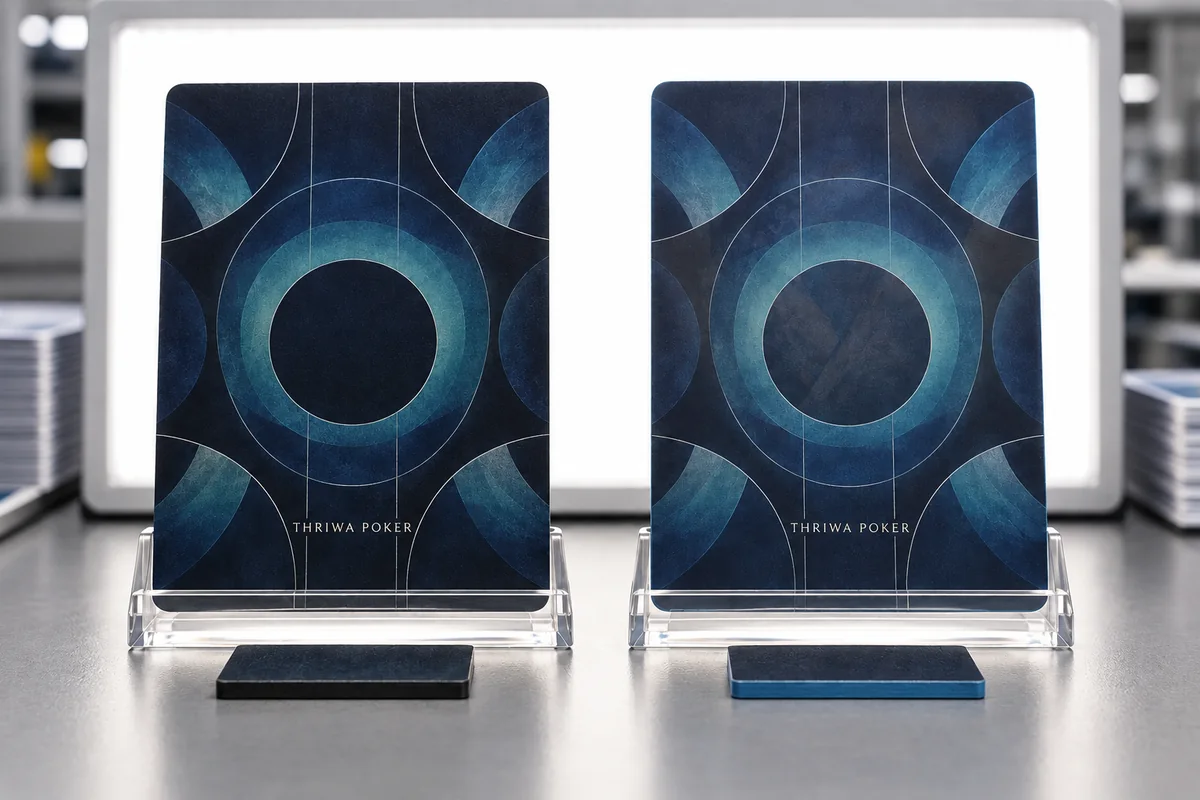
A modern playing card is not a single sheet of paper. It is a sandwich: a printed face sheet, a center core, and a printed back sheet, bonded together under heat and pressure. Light behaves differently in each layer. When a lamp shines on the back of a card, the light first passes through the back sheet, then hits the core, and finally travels through the face sheet. Whatever the core absorbs, the player never sees. Whatever the core lets through, the player sees as a shadow of the front design. That is why the center layer, not the printed surface, is the real gatekeeper of card opacity. Black core paper puts a dark, dense center layer inside the sandwich. That dark middle absorbs a large share of visible light before it can reach the face sheet, so a card back tends to look uniform even when a bright light sits behind it. Blue core paper uses a blue-tinted center instead. It still blocks light better than a plain single-ply sheet, but its color and density absorb less than a black core, so more light travels through under strong backlighting. Coated art paper is usually a simpler paperboard base with printing and coating on both faces; it offers a smoother, brighter surface for artwork but no dedicated dark core, which makes it a weaker choice when hidden information matters. Paper thickness, coating weight, and the glue line between layers all shift the result slightly, but the core color and density set the baseline.
Why Black Core Paper Supports Competitive Hidden Information
In a competitive match, information is the product. A player who can identify the top card of a deck or a face-down card in a sleeve gains an unfair edge, and that is exactly what backlighting reveals. Tournament organizers, publishers, and serious players have treated backlighting as a known concern for years, which is why the center layer became a design decision rather than an afterthought. Black core paper does not make a card invisible under light. It raises the amount of light the card can absorb before the front art becomes readable from behind, and in real play that threshold is usually more than enough for normal indoor lighting, table lamps, and overhead venue lights.
1. Backlighting Checks Make the Core the First Line of Defense
The common player habit is simple: hold the card back toward a light source and look for the shape of the front design. The eye is very good at picking up faint contrast, so even a small amount of transmission shows up as a ghost image. A dark center layer cuts that transmission at the source. Because the black core sits between the two printed sheets, it also hides minor differences in ink coverage on the face side, which stops a heavy ink area from reading as a darker patch from behind. German black core and Japan black core both follow the same principle: a dense, dark middle layer bonded between two printed sheets, with the exact fiber blend and caliper chosen by the mill. The result is a card that feels solid in the hand and stays visually uniform when light hits the back.
2. Shuffle Rigidity and Wear Change How Long Opacity Lasts
Opacity is not only about the core color. It is also about how the card holds its shape through shuffling, cutting, and handling. A card that bends easily develops creases along the edge, and a crease compresses the board locally, which lets more light through at that spot. Black core stock is generally described as resilient, meaning it springs back toward flat after a riffle or a bridge instead of staying bent. That resilience keeps the layer structure intact longer, so the light-blocking behavior stays consistent across a full session. Blue core and coated art paper can still hold up fine in casual play, but in a deck that sees hundreds of shuffles a week, the core's recovery matters as much as its color.
Where Blue Core and Coated Paper Fit in Board Game Decks
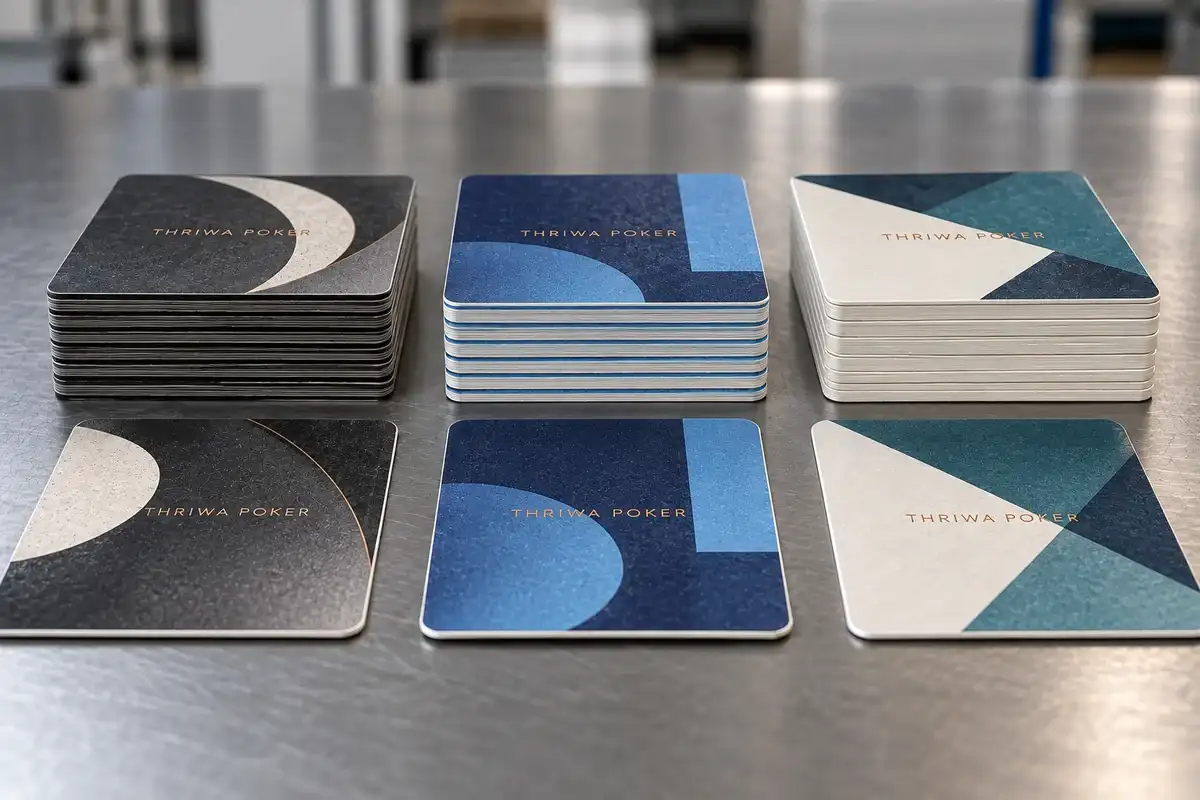
Blue core paper earns its place in board game decks for different reasons. It is a familiar, cost-effective option for cards where hidden information is not the main concern, such as resource cards, event decks, or player boards that never sit face-down in a hidden zone. It still offers a multi-layer build with a tinted center, so it blocks more light than a plain sheet, and it prints cleanly on both faces. For custom board game card printing runs where the deck is meant to be seen and handled openly, blue core often gives the best balance of print quality, stiffness, and unit cost. It also die-cuts and corners reliably, which matters when a game ships with several card sizes in the same box. Coated art paper, sometimes called C2S art paper, plays a different role again. Its strength is surface: a smooth, bright face that takes fine detail and rich color, which is why it shows up in score pads, reference cards, promotional inserts, and cards that live face-up on the table. It has no dedicated dark center layer, so it is not the right pick when a player could gain an advantage by peeking through the back. In a mixed board game box, publishers often combine materials: art paper for visible components, blue core for the working deck, and black core for the cards that carry hidden information. Bringing those choices together under one roof is what a custom board game card manufacturer or a custom trading cards manufacturer actually coordinates, because trading card printing and packaging decisions interact with sleeve fit, deck box height, and shuffle feel. That material mix also shapes packaging. A game card printing factory that handles both core stocks and coated sheets can keep the caliper consistent across a set, so a deck box designed for one card type still fits the others. For collectors, the difference shows up in small ways — a firmer snap during a riffle, a card back that stays even under a reading lamp, edges that hold their shape after months of play. None of that comes from the artwork. It comes from the core.
Conclusion
Black core paper and blue core paper are not competing for the same job. Black core puts a dark, dense center inside the sandwich that absorbs light before it reaches the face sheet, which is why it supports hidden information in competitive play. Blue core offers a balanced, cost-effective multi-layer build for decks that are handled openly, and coated art paper delivers a bright printing surface for visible components. The practical takeaway for anyone comparing materials is to look past the surface finish and ask what sits in the middle, then consider how often the deck gets shuffled and how much light it will realistically face. THRIWA POKER lists German black core, Japan black core, blue core, and art paper as available material options, and sample cards are the fastest way to feel the difference in stiffness and light blocking before committing to a full run.
FAQ
Q: How does black core paper reduce light passing through a trading card?
A: A trading card is a sandwich of face sheet, core, and back sheet. Black core paper places a dark, dense layer in the middle of that sandwich. When light hits the card back, the dark core absorbs most of the visible light before it can travel through to the face sheet, so the front design does not read as a ghost image from behind. Paper thickness, coating, and the glue bond all add to the effect, but the dark center does most of the work. It greatly reduces transmission and no card is completely immune to strong backlighting.
Q: What is the difference between black core and blue core paper in card printing?
A: Both are multi-layer card stocks with a colored center, but the center differs. Black core uses a dark, light-absorbing layer that is chosen when card backs need to stay uniform under a lamp or an overhead venue light. Blue core uses a blue-tinted center that still blocks more light than a plain sheet, yet absorbs less than a black core. Blue core is usually the more economical option for decks that are played face-up, while black core is the pick when hidden information and shuffle resilience matter most.
Q: Are German black core and Japanese black core paper used for the same game card applications?
A: Yes, they serve the same basic purpose: a dark center layer bonded between two printed sheets to reduce light transmission and give the card a firm, springy feel. The two differ mainly in fiber source, mill process, and the exact caliper of the sheet. Both are used for competitive TCG cards and collector-grade decks where opacity and shuffle recovery matter. Exact grammage is not stated in the available product facts, so the best way to compare them is a physical sample.
Sources / References
Raw Material Selection & Use information - Eupia
Chain of Custody Certification - Forest Stewardship Council

