

Introduction: A matte anti-slip coating on plastic playing cards scatters light to cut glare while tuning friction for steady shuffling and dealing.
Something changes at the table when the lights run bright. A glossy card face throws a hard streak of white across the artwork, and players tilt their heads to read a rank. A matte card does not do that. For independent card designers choosing a finish for custom plastic playing cards, this is not a small aesthetic choice. It decides whether the illustrations stay readable, how the deck feels in the middle of a shuffle, and how the surface holds up after weeks of regular play. The goal here is to explain what actually happens at the surface level, so a designer can judge whether a matte finish fits the deck they are building.
Why bright light makes glossy card surfaces harder to read
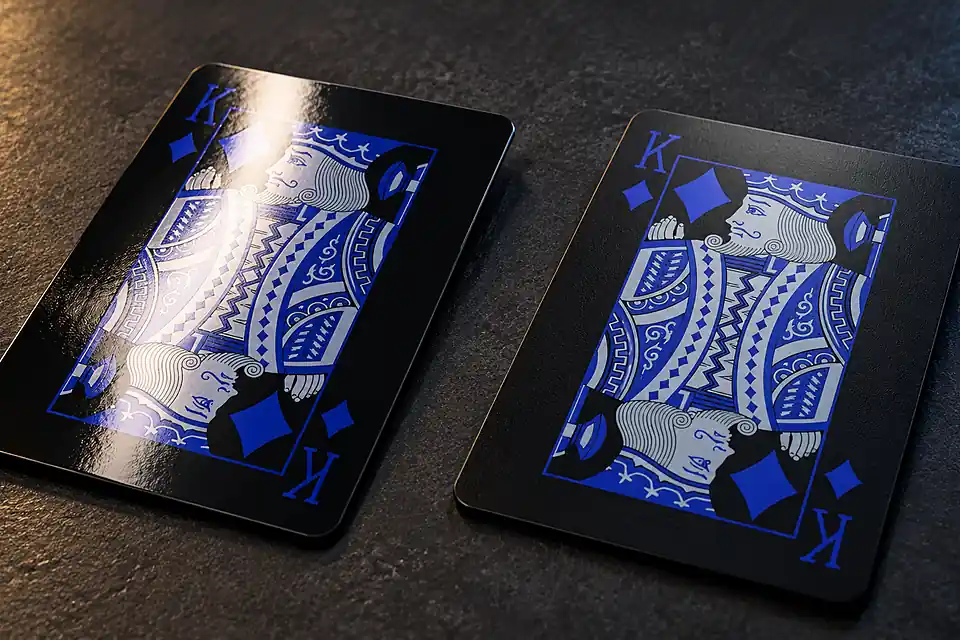
Light behaves differently depending on how smooth a surface is. A glossy card face is close to a mirror at the microscopic level. When light from a ceiling fixture or a nearby window hits it, most of that light bounces off at one predictable angle. If your eye happens to sit at that angle, you get a hot spot — a bright patch that wipes out whatever sits underneath. On a poker table with overhead lamps, that hot spot can land right on the numbers or the suit pips, and the card becomes hard to read even though nothing is wrong with the printing or the base sheet. It is a reflection problem, not a print problem. A matte surface breaks that single-angle bounce. Instead of one clean reflection, the texture sends light off in many directions at once. The surface looks softer, and the hot spot spreads into a general lightening rather than a bright glare. What matters for card design is that detail survives. Fine line work, thin type, and low-contrast areas stay visible because they are no longer overpowered by a reflection. Designers who draw dark artwork with subtle values usually notice the biggest difference, because those values are the first thing a glossy reflection erases. The same principle explains why matte finishes show up on reading surfaces, monitors, and photo prints where readability under a lamp matters more than shine. On a card table, the practical effect is simple: a player can read the artwork without changing their viewing angle.
How matte surface texture balances grip and glide during dealing
A matte coating does two things at once, and the combination sounds contradictory at first. It reduces glare, which usually means a rougher surface, and it keeps enough friction to stop cards from spraying out of your hand during a fast deal. Both can be true because the texture is working on two different contact problems: how much light bounces back, and how much resistance a fingertip or a neighboring card meets. Getting the balance right is a coating formulation job, not a simple sanding job. Here is what each piece does at a real table.
- Glare reduction. The micro-texture scatters incoming light across many angles instead of one, so bright overhead lamps no longer produce a hard hot spot that hides the artwork underneath.
- Thumb friction. The same texture gives skin more contact points, so the top card stays under your thumb during a deal instead of sliding forward on its own before you are ready.
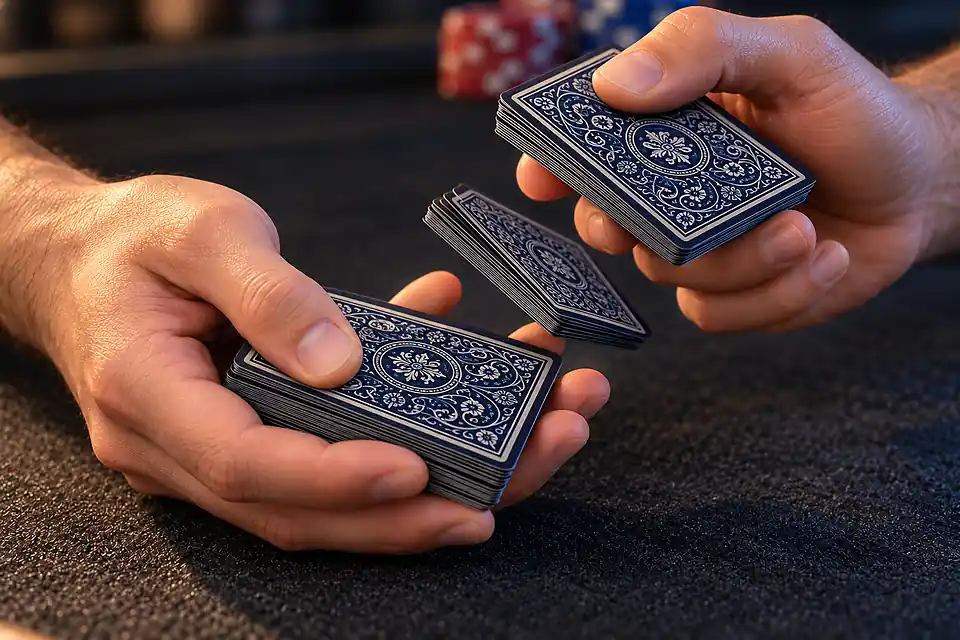
- Shuffle glide. Cards still slide across each other in a riffle or a wash because the coating controls friction rather than removing it, so the deck moves cleanly instead of grabbing.
- Fingertip control. Because the surface feels slightly grippy rather than slick, small adjustments such as squaring the deck, peeling one card, or cutting a packet feel predictable instead of loose.
That balance is why a matte finish is best described as anti-slip rather than non-slip. The surface is tuned, not frictionless. If the coat were slicker than the card edges allowed, a designer would see decks slide apart on a hard table and thumbs slip during a cut. If it were too grippy, riffle shuffles would jam and cards would clump into blocks. The useful range sits somewhere in the middle, and where exactly that range lands depends on the whole ink, coating, and PVC system rather than on the matte label by itself.
What coating wear means for long-term handling feel
Coating is thin, and it sits on top of a non-porous PVC sheet. That combination drives the long-term story. PVC does not absorb moisture the way paper does, so the coating has no fiber network to sink into. It bonds to the plastic surface through its own formulation, and that bond decides how the coating behaves after hundreds of shuffles. Polymer films generally recover their shape after being flexed within their elastic range, which is why a plastic card snaps back instead of creasing. A coating that has thinned or lifted locally does not recover the same way, and the difference often shows up first as shiny patches where the texture has been rubbed smooth. Over time, three changes usually appear on a heavily used deck. Hand oils and table grit polish the high points of the texture, which slowly raises local gloss. Repeated sliding thins the coating in the middle of the card face, where shuffling contact is heaviest. And on a card handled thousands of times, the friction that felt balanced on day one can drift toward slick in worn areas and grippier near the edges. None of that means the deck is falling apart. It means the surface has changed, and a designer selling a plastic deck should expect the coating layer to age differently than the PVC core beneath it. A PVC plastic poker playing card built with a double-sided matte anti-slip coating over a 100% new PVC base, with full-color printing underneath, depends on that coating to hold its texture rather than on the card body itself. That is also where the full material system matters more than the finish label. Matte describes a surface, not a safety rating. Surface-contact compliance depends on the ink, coating, and base material together, along with the limits each market applies to those materials. A designer who wants a specific claim on a retail deck should look at the entire stack — pigments, coating chemistry, and PVC grade — rather than treating the word "matte" as a shortcut.
Conclusion
A matte anti-slip coating changes plastic playing card handling in three connected ways. It scatters light so bright rooms stop washing out the artwork. It tunes friction so a thumb holds the top card while riffle shuffles still glide. And it introduces a surface layer that will age at its own pace, independent of the PVC core beneath it. For an independent card designer, the practical takeaway is that matte is not only a look. It is a friction and light-management decision that shapes how a deck performs on a real table, and it is worth checking against the room and the shuffle style the deck is built for.
FAQ
Q: How does a matte anti-slip coating change the way plastic playing cards handle?
A: A matte anti-slip coating changes handling by adding a fine surface texture that scatters light and increases skin contact without making the cards sticky. The result is a deck that feels slightly grippy in the hand, holds steady during a deal, and still slides cleanly during a riffle shuffle, instead of being either too slick or too grabby.
Q: Does a matte finish reduce glare without making cards too slippery?
A: Yes, a well-formulated matte finish reduces glare without turning the deck slick. The micro-texture scatters reflection in many directions and increases friction against fingertips, so the surface reads as anti-slip rather than non-slip. How much grip a specific deck offers still depends on its ink and coating system, not on the word "matte" alone.
Q: How do coated plastic cards feel during repeated dealing?
A: During repeated dealing, coated plastic cards feel slightly grippy on the thumb and smooth against each other. As the coating warms and picks up hand oils, the surface can start to feel a little slicker in the middle of the card face while the edges stay grippier. That drift is normal surface wear, not a defect, and it is one reason a light wipe-down helps keep the original feel.
Sources / References
Toy safety - Internal Market, Industry, Entrepreneurship and SMEs


